What re-roofing and re-slating mean
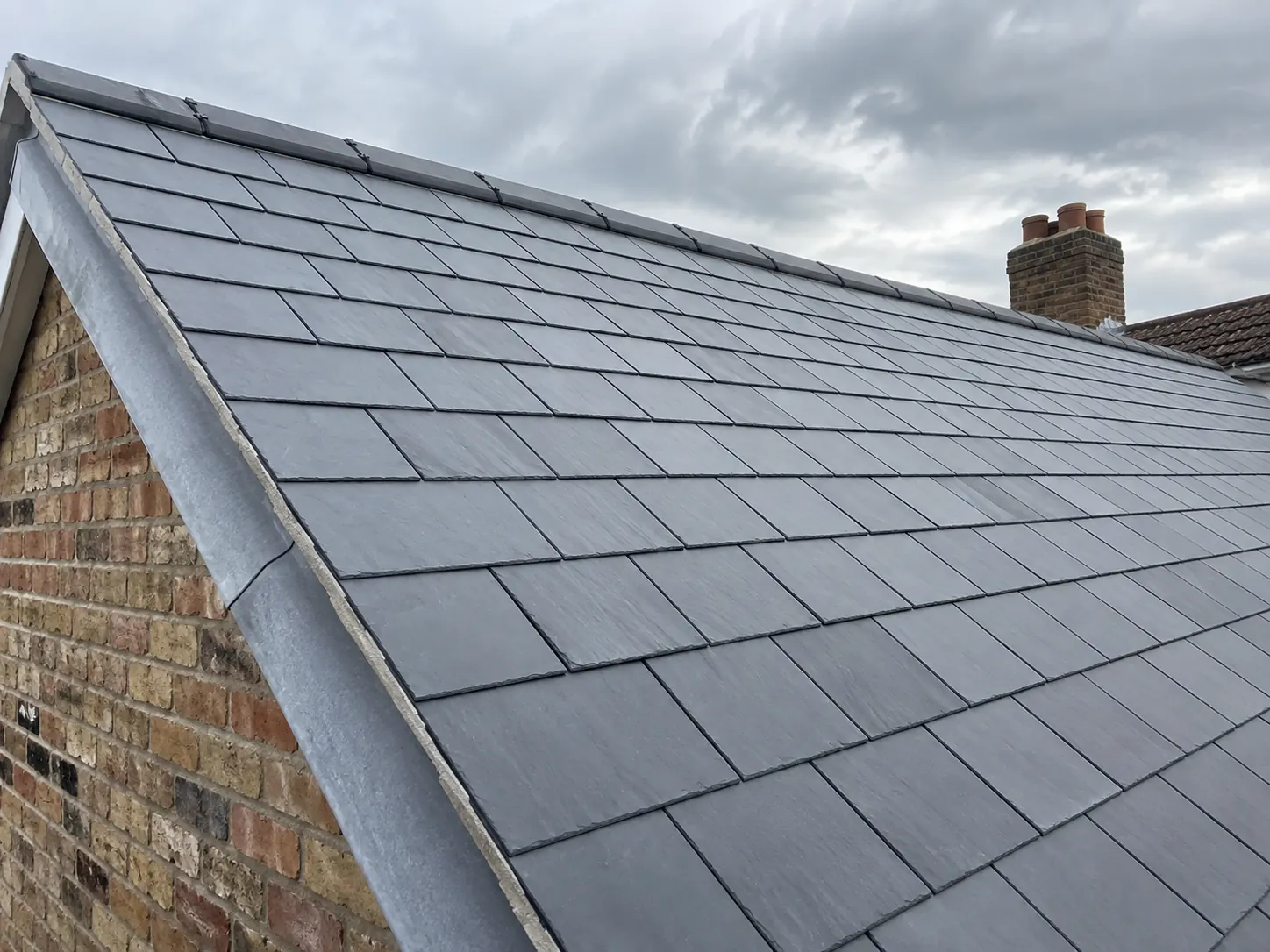
Re-roofing is the general term for stripping an existing roof back and covering it again. Re-slating is the same process applied to a roof finished in natural slate: the old slates come off, the roof structure is checked, new underlay and battens go on, and slates are laid again from eaves to ridge. It is a traditional way of renewing a roof and keeps the character that slate gives a period home.
It differs from a slate repair, which deals with a handful of slipped or cracked slates, and from a brand new roof on an extension or new build, which has no existing covering to remove first.
Signs a slate roof is ready for re-slating
A roof that only needs one or two slates refitted each year is still earning its keep. One that is slipping in several places every winter, where nails have rusted through across more than one slope, or where earlier patch repairs are held on with tingles and sealant, is telling a different story. Daylight showing through the sarking boards in the loft, or underlay that has gone brittle and torn, points the same way.
We look at the whole roof rather than the obvious gap, so the advice reflects what is actually happening across every slope, not just the part you can see from the street.
Is it worth re-slating rather than fitting a new roof?
Re-slating and a new roof are closely related: both involve stripping the old covering and rebuilding from the timbers up. The real choice most homeowners face is between another round of repairs and re-slating the whole roof. Once slipping and leaks are spread across several slopes, paying for access and labour again and again tends to cost more over time than carrying out the work once, properly.
Reusing sound existing slates where possible is part of what makes re-slating worthwhile on an older property, as it keeps the appearance of the house while renewing everything underneath that cannot be seen.
How a re-slating job is carried out
Safe access comes first, almost always scaffolding rather than ladders, since the whole roof is being worked on rather than one small area. The existing slates are removed section by section, and the timbers underneath, rafters and sarking boards, are inspected and repaired where needed. New breathable underlay and battens are then fitted to suit the slate being used.
Slates are hung again from the eaves upward, with sound slates reused where they pass inspection and the remainder made up to match. Ridges, hips, lead flashings at chimneys and valleys, and the verges at the gables are finished to complete the roof, and gutters are checked while the access is in place.
Are slate roofs expensive to re-slate?
We do not quote figures without seeing the roof, because re-slating is priced on the job rather than a standard rate. What shapes the cost is the size and pitch of the roof, how many slopes and chimneys it has, whether valleys and dormers add complexity, how much timber repair the survey uncovers, whether existing slates can be reused or need sourcing to match, and the scaffolding and access the property requires. Our roofing costs guide sets these factors out in more depth.
A steep, simple roof on a bungalow is a different job from a tall villa with several chimneys and valleys, and the quote reflects that difference rather than a flat price per slate.
Permissions and pitch
Re-slating a traditional home sometimes raises questions about planning or conservation rules, particularly where the property sits in a conservation area; our guide to building warrants for a new roof explains when permission needs checking. The pitch of the roof also matters, since every slate has a minimum angle it can be laid at before it lets water through at the overlaps; our guide to minimum pitch for a slate roof covers this for shallow porches and dormers.
If you are weighing up slate against another material while the roof is stripped back, our slate vs tile roofs guide compares the two side by side.
Talking it through with a family firm
Rowan Roofing has traded for 16 years and the family behind it brings over 50 years of roofing experience. We are based in Cardenden, Fife, and travel up to 50 miles, covering Edinburgh, Perth and Dundee as well as the surrounding towns. We survey the roof first, explain honestly whether a repair or re-slating is the better route, and set the proposed work out in a written quote before anything is booked in.
Re-slating questions
What is re-roofing?
Re-roofing means stripping an existing roof back to the timbers and covering it again, with new underlay, battens and a slate or tile finish. Re-slating is re-roofing carried out with natural slate.
Is it worth re-slating rather than a new roof?
On a traditional home, re-slating is usually what a new roof means, since the aim is to renew the roof in keeping with the property. The real decision is usually between repeated repairs and re-slating the whole roof once the faults have spread across several slopes.
Are slate roofs expensive?
Slate generally costs more to buy and takes longer to lay than other materials, but the overall price also depends on the roof's size, pitch, chimneys and valleys, the timber repairs needed and the access required, which is why we quote after a survey rather than from a standard figure.
Can my existing slates be reused?
Often, yes. Natural slate frequently outlasts its fixings, so sound slates are sorted and reused where possible when a roof is stripped, with the rest made up to match.
Opening a pitched roof is an opportunity to consider roof insulation at rafter level, together with ventilation and the junctions around dormers.
Ask for a written quote
Call 07508 571291 (Mon–Fri 7:30am–6:00pm, Sat 8:00am–12:00pm) or send your details through our contact page.