Need this sorted?
Need help with new roofs? Get a quote from Rowan Roofing.
The short answer
Natural slate is the traditional covering on a great many Scottish homes. It is thin, dense, long-lasting and very good at shedding rain. Tiles — usually concrete, sometimes clay — are thicker, heavier per square metre, generally quicker to lay and often less expensive overall.
On a traditional property, slate is usually the natural choice for appearance and may be expected by planners. On many post-war and modern homes, tiles are what the roof was designed for.
Appearance
Slate gives a flat, crisp, dark grey finish with fine lines — the look of most older town and village streets in central Scotland. Tiles come in more shapes and colours, from flat interlocking profiles to rounded pantiles, and look chunkier from the street. Matching what neighbouring houses have usually looks best.
Weight and structure
This is often overlooked. Concrete tiles are heavier than slate, so switching a slate roof to concrete tiles can put extra load on rafters that were never designed for it. Going the other way is usually less of a concern. Any change of material should start with a look at the roof timbers, which is part of our survey.
New roofs
- Slate, tile and flat roofing options.
- A full survey and clear written quotation.
Lifespan and maintenance
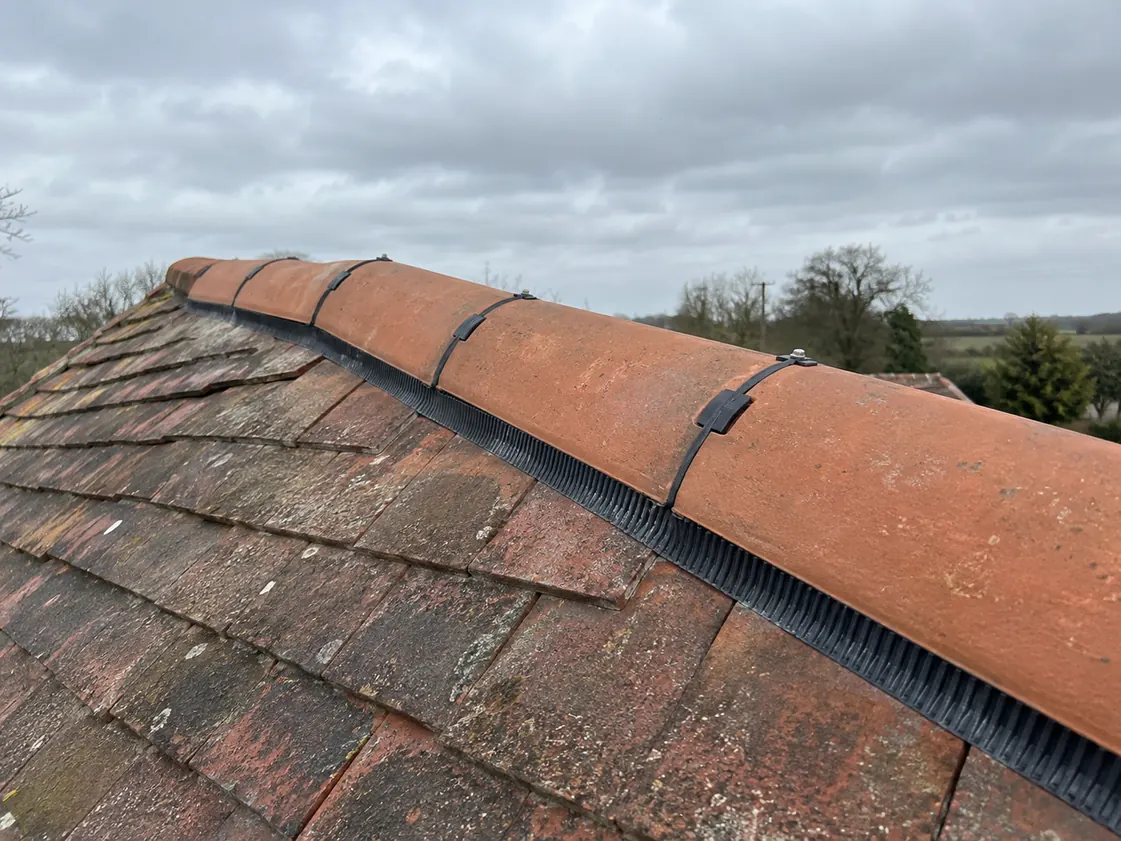
Good natural slate can outlast several sets of fixings; many old roofs fail because the nails rust, not because the slates wear out. That is why reclaimed slate is sometimes reused. Concrete tiles are durable but their surface slowly erodes and they can become more porous with age. Clay tiles keep their colour well but can be brittle underfoot.
Either way, a roof lasts as long as its weakest detail — ridge, valleys, flashings and underlay matter as much as the covering itself.
Coping with Scottish weather
Wind and driving rain are the main tests here. Slate laid at the correct overlap and properly fixed is extremely weather-resistant. Interlocking tiles are also designed to resist wind uplift, and modern clips and dry ridge systems help. What matters most is that the roof pitch suits the chosen material, because each slate or tile has a minimum pitch below which it will let water in.
For slate, that lower limit is not one fixed angle: it depends on the size of the slate, the headlap and how exposed the slope is to wind-driven rain, with manufacturers' figures and BS 5534 setting the numbers. Our guide to the minimum pitch for a slate roof explains what to ask before slate goes on a shallow slope.
Cost factors
We do not publish prices because every roof is different, but it helps to know what drives cost. Natural slate is generally the more expensive material and slower to lay, as each piece is holed and fixed individually. Tiles are usually quicker, which reduces labour. Access, roof size and complexity, chimneys, dormers and valleys, and the condition of the timbers affect the final figure more than many people expect.
Where flat roofs fit in
Neither slate nor tile works on a flat or very low-pitched roof, such as a single-storey extension or dormer top. Those areas need a flat roof covering, and it is common for one home to have a slate or tiled main roof with flat sections alongside.
Questions to ask before you decide
What was the roof originally built for? What do the neighbouring houses have? Is the house in a conservation area? How long do you plan to stay? Is the timber structure in good order? The answers usually point clearly one way.
If you are still undecided, we can talk through both options on site, looking at your actual roof rather than a brochure, so the choice is based on what will work on your house.
Honest advice from a family firm
Rowan Roofing is a family-run business based in Cardenden, Fife, trading for 16 years with over 50 years of roofing experience in the family. New roofs are what we specialise in, and we work on slate, tile and flat roofs across Edinburgh, Perth and Dundee, travelling up to 50 miles for the right job.
We will look at your roof and recommend what genuinely suits it, then set it out in a written quote. Call 07508 571291, Monday to Friday 7:30am to 6:00pm or Saturday 8:00am to 12:00pm.
Want a professional to handle it?
Frequently asked questions
Can slate go on a low-pitched roof?
Only down to a point. Larger slates with more headlap can cope with flatter slopes, but every slate has a published lower limit, and exposed sites need a steeper angle.
Which is lighter, slate or concrete tile?
Natural slate is generally lighter per square metre than concrete tiles, which is why changing a slate roof to concrete tiles needs a check on the roof timbers first.
Need a slater?
For slipped, cracked or missing slates, see our slate roof repairs page, or our Edinburgh roofers and slaters page if you are in the capital. Call 07508 571291 or use our contact page.
Related services
Covering Edinburgh, Perth and Dundee.