
Need this sorted?
Need help with roof leak repairs? Get a quote from Rowan Roofing.
Water coming through the ceiling
Water coming through the ceiling needs prompt attention, even if the visible patch looks small. Catch drips in a container, move furniture and valuables, and keep clear if the ceiling is bulging. If water is near a light fitting or socket, switch off the affected circuit if safe to do so. Do not climb onto the roof.
The stain can appear far from the entry point because water follows rafters, sarking or insulation. Note when the mark appears and whether it worsens in wind-driven rain; these details help an inspection narrow down the source.
What to do straight away
Put a bucket or tray under the drip and move anything valuable out of the way. If the ceiling is bulging with water, keep people out of the room. Where lights or sockets are near the wet area, switch off that circuit at the fuse board.
If you can safely get into the loft, a torch will often show where water is coming through the underside of the roof. Take a photo — it helps us enormously. Do not go onto the roof yourself, especially in wet or windy weather.
Cause 1: slipped, cracked or missing slates and tiles
The most common cause. Storms lift slates, fixings corrode, and a single gap lets rain onto the underlay beneath. On older roofs the underlay may have perished, so there is nothing behind the gap to stop the water.
The fix is to replace or re-fix the affected slates or tiles, and check the ones around them. If lots are going at once, it may point to a wider problem with the fixings, which is worth knowing before paying for repeated call-outs.
Roof leak repairs
- Finding the source of a leak before quoting for a repair.
- Repairs to slates, flashing, valleys, flat roofs and gutters.
Cause 2: flashing around chimneys and walls
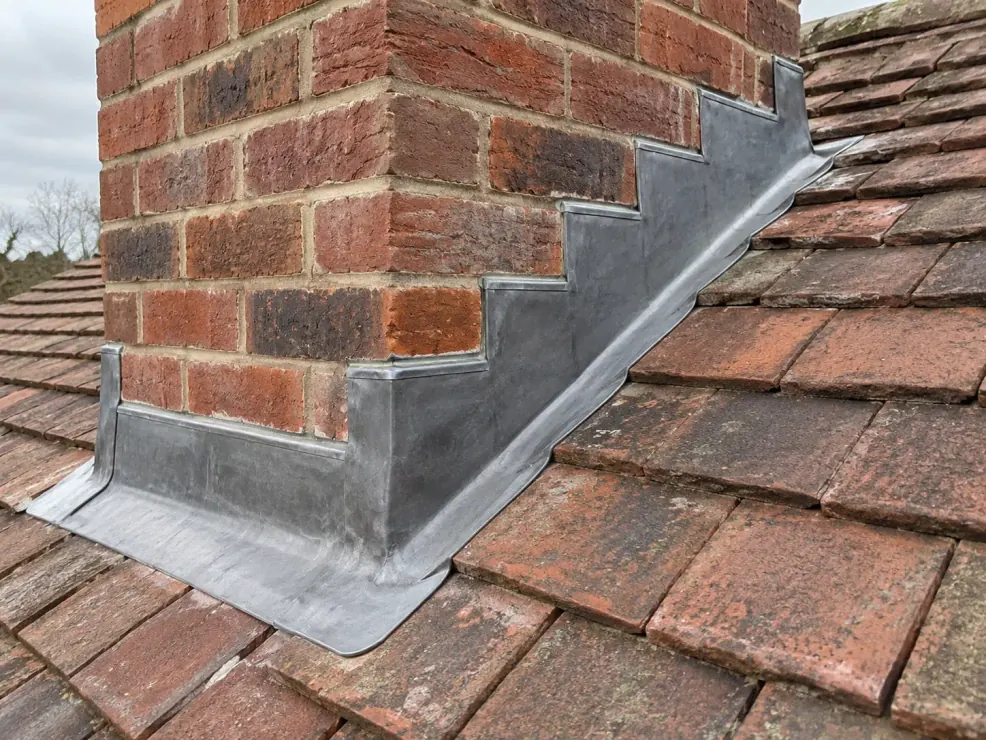
If the leak appears near a chimney breast or where a lower roof meets a house wall, suspect the lead flashing. Lifted, split or sealant-patched lead lets wind-driven rain behind it. Repairs range from re-dressing the existing lead to fitting new flashings.
Cause 3: valleys
Valleys channel water from two slopes, so a small defect there lets in a lot. Leaves and moss can also block the valley and push water sideways under the slates. Clearing it may be enough; a split or worn valley lining needs renewing. Damp near the internal corner or staining that follows a rafter can offer clues, but avoid clearing a roof valley yourself. A roofer can inspect the channel, its edges and surrounding coverings together.
Cause 4: flat roof failures
Extensions, dormers and garages with flat roofs leak through splits, blisters, failed edges and poorly sealed rooflights. Because water spreads across the deck, the stain inside can be some distance from the defect. Small splits can be repaired; a roof with a soft, wet deck usually needs renewing.
Cause 5: gutters and the roof edge
Damp appearing high on an outside wall or around the top of a window is often a gutter problem rather than a roof problem. Blocked or dropped gutters overflow and soak the wall and fascia. Clearing, re-hanging or replacing the gutter solves it.
Cause 6: ridge and hips
Ridge tiles bedded in mortar can loosen as the mortar ages, letting water in along the top of the roof. Re-bedding or securing the ridge puts this right.
Hips — the sloping external corners on some roofs — are finished the same way and suffer the same problem. After a windy spell, pieces of old mortar in the gutter or on the ground below are a useful clue that the ridge or hips need attention before the next spell of wet weather arrives.
Common causes and a roof that keeps leaking
When a roof keeps leaking after earlier patching, the visible defect may not be the only fault. Water can enter at a nearby flashing, valley or ridge and travel before it shows indoors. Repeated leaks can signal widespread tired fixings, deteriorated underlay or more than one entry point.
A useful inspection considers the roof as a system rather than treating each ceiling mark separately. We check the covering, junctions and drainage, then explain whether a focused repair is sensible or whether the broader condition needs attention. Read about flat roof leaking and chimney leaking.
It might not be the roof at all
Condensation in a poorly ventilated loft can drip from nails and timbers and look very like a leak, particularly in cold weather. Plumbing from a water tank or pipework in the loft is another possibility. If the damp appears on dry days, mention it — it helps rule the roof in or out.
How we track a leak down
We look at the stain inside, the loft, and the roof above, working back from where the water shows to where it enters. We then explain what we found, what needs doing, and whether it is a straightforward repair or a sign of something bigger. You get that in a clear written quote before any work starts.
Rowan Roofing is a family-run business from Cardenden, Fife, with 16 years trading and over 50 years of experience in the family, covering Edinburgh, Perth and Dundee. Call 07508 571291 — Monday to Friday 7:30am to 6:00pm, Saturday 8:00am to 12:00pm.
If the leak is active or roofing materials have moved, read how to contact us about emergency roof repairs.
Want a professional to handle it?
Frequently asked questions
Will a roof leak get worse if I leave it?
Usually yes. Water that keeps entering can damage timbers, insulation and plaster over time, and a small defect can grow as materials move. Having it looked at early keeps the repair simpler.
Why does my roof only leak in heavy or wind-driven rain?
Some faults only let water in when rain is driven at an angle or the volume overwhelms a drainage path. Noting the weather when leaks appear helps an inspection narrow down the entry point.
Can a valley cause a leak in the middle of the ceiling?
Yes. A blocked or split valley can let a large volume of water onto the underlay, and it can travel along timbers before showing well away from the valley itself.
Should I go into the loft when it is raining to find the leak?
Only if the loft is safe and dry underfoot. A torch can show where water is coming through the underside of the roof, but never go onto the roof itself, and keep clear of wet electrical fittings.
Need a leak repaired?
If you need the repair itself rather than help diagnosing it, see our roof leak repairs page, or call 07508 571291 for a quote.
A low-pitched covering needs its own checks: see flat roof leaking for observations you can make safely indoors and from ground level.
If a leak comes with dipping or bowing, read sagging roof: causes and what to do.
A wet roof window needs different checks: read leaking Velux windows. If the problem only appears during a downpour, see roof leaking in heavy rain.
Related services
Covering Edinburgh, Perth and Dundee.