
Need this sorted?
Need help with flat roof repairs? Get a quote from Rowan Roofing.
Start inside: where and when does the mark appear?
Note exactly where the stain or drip sits on the ceiling, bearing in mind water can travel sideways along joists before it shows. Note whether it appears only during or just after rain, or is there all the time, since a constant damp patch can point to condensation rather than a leak.
Where the underside is visible from a safe floor position, such as inside a garage, photograph staining or drip marks without touching wet electrical fittings or disturbing ceiling materials. Do not enter a cramped or damaged space merely to inspect. Water may travel along timber, so those marks are clues to pass on rather than proof of an entry point.
Look from the ground before you look from above
From a safe spot on the ground, or an upstairs window if the roof is overlooked, you can often see a surprising amount. Ponding, where water sits in a shallow puddle for more than a day or two after rain, shows as a darker, sometimes shinier patch. Debris such as leaves or moss collecting in one area can also hold water against the covering for longer.
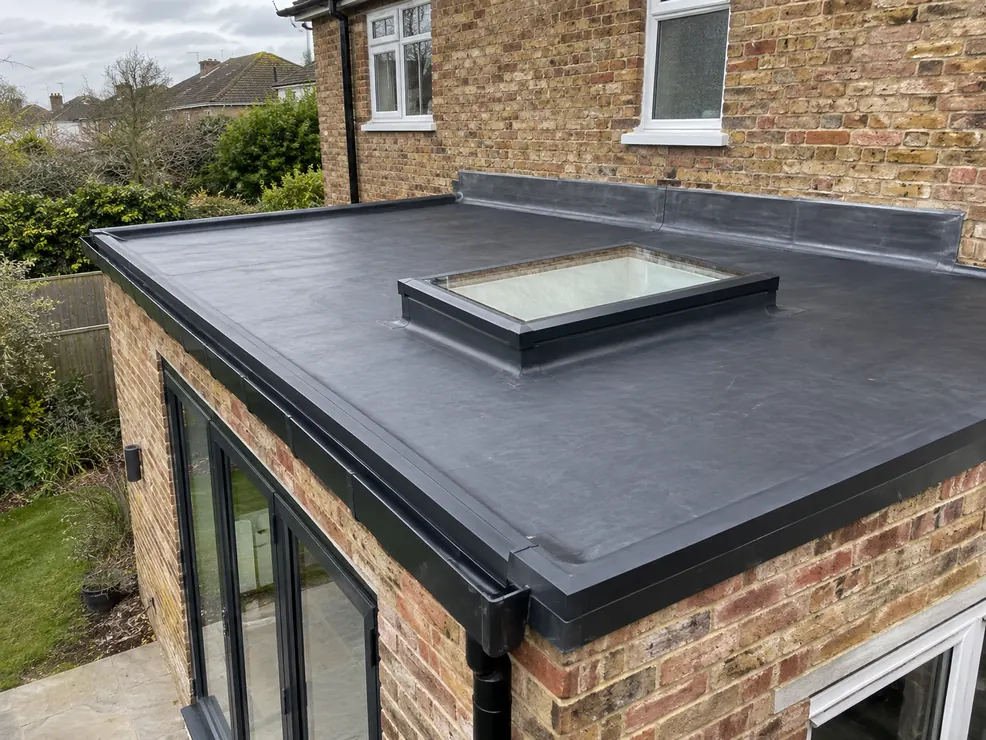
Look too at the edges and upstands where the roof meets a wall, chimney or parapet. A lifted edge trim, a gap in flashing against brickwork, or a visible split near a corner are things you may spot without climbing up, especially with binoculars.
Common causes behind a flat roof leak
Splits and cracks in the surface covering let water straight through, tending to appear first at corners, upstands and anywhere the roof has flexed. A failed joint where two sheets meet, or where the covering meets a flashing, is another frequent cause and can be harder to spot than an open split. Blocked or poorly fitted outlets stop water draining away, so it sits on the roof longer and increases the chance of finding a way in.
Blistering, where trapped moisture pushes the covering into a bubble, weakens the surface and can eventually crack open. Flashing that has lifted or corroded at a wall junction is also common, and being tucked against brickwork it is often blamed on the wall rather than the roof.
Flat roof repairs
- Repairs to splits, blisters, open laps and edge details on flat roofs.
- Checking the deck and falls before quoting for a repair.
Condensation versus a leak
Not every damp patch is a leak from outside. Poor ventilation in a garage, utility room or flat-roofed extension can lead to condensation forming on the underside of the roof structure, which then drips or stains in a way that looks similar to a leak. Condensation tends to appear in cold weather regardless of rain, and is often worse where a room is warm and humid, such as above a shower or kitchen. Telling the two apart usually needs a proper look at the roof and the space beneath it.
What not to do while you wait
Do not go onto a flat roof to inspect or try to patch it yourself. Flat roofs can hide soft or rotten decking that is not obvious from the surface, and the covering itself can be slippery when wet. If water is actively coming through into the house, a bucket and moving anything valuable out of the way is the sensible immediate step indoors, rather than attempting access outside.
When to call for a repair or a replacement
A single split, a lifted flashing or a failed joint on an otherwise sound roof is usually a repair. A roof with ponding across much of its surface, several areas of blistering, or a history of repeated patching is more likely heading towards a full replacement. If the leak is active and causing damage inside the house right now, that is a situation for an emergency call rather than waiting for a routine visit. Where renewal is being discussed, flat roof replacement explains the separate service.
Describe the material if you know it: felt can split or lift at laps, EPDM can leak at damaged areas or perimeter junctions, and GRP may crack or separate around trims. An indoor stain cannot distinguish these on its own. For ongoing water ingress, see emergency roof repairs; availability remains within the stated hours, with the contact form for enquiries outside them.
Get a proper look at your flat roof
Send the position of the damp mark, the weather when it appears and any photographs taken safely. Mention whether the affected space is heated and whether the problem changes with room use. Our flat roof repairs page covers arranging work; the observations here are preparation for an inspection, not a diagnosis that replaces one.
Want a professional to handle it?
Frequently asked questions
Why does my flat roof only leak sometimes?
A small split or failed joint may only let water through during heavy or wind-driven rain, or once ponding builds up after several wet days, which is why a leak can seem to come and go.
Could the leak be coming from somewhere other than the roof covering?
Yes. Flashing at a wall junction, a blocked outlet, or condensation from poor ventilation underneath can all produce symptoms that look like a covering failure.
Is a damp smell without a visible stain still worth checking?
Yes. A persistent musty smell can appear before a stain becomes visible, particularly if water is tracking along timbers before it shows on the ceiling surface.
Should I try to clear ponding water myself?
It is best left to a roofer. What looks like standing water from the ground can hide a soft or damaged covering underneath, and getting onto a flat roof safely needs the right equipment.
What should I do if water is actively dripping inside right now?
Protect the area indoors and get in touch straight away rather than waiting for a routine appointment, since active water ingress can worsen quickly.
Need it sorted? Book a flat roof repair
See our flat roof repairs page for how we fix leaks, or get in touch if you need us to take a look.
Related services
Covering Edinburgh, Perth and Dundee.