
Need this sorted?
Need help with tiled roof work? Get a quote from Rowan Roofing.
How concrete and clay tiles differ
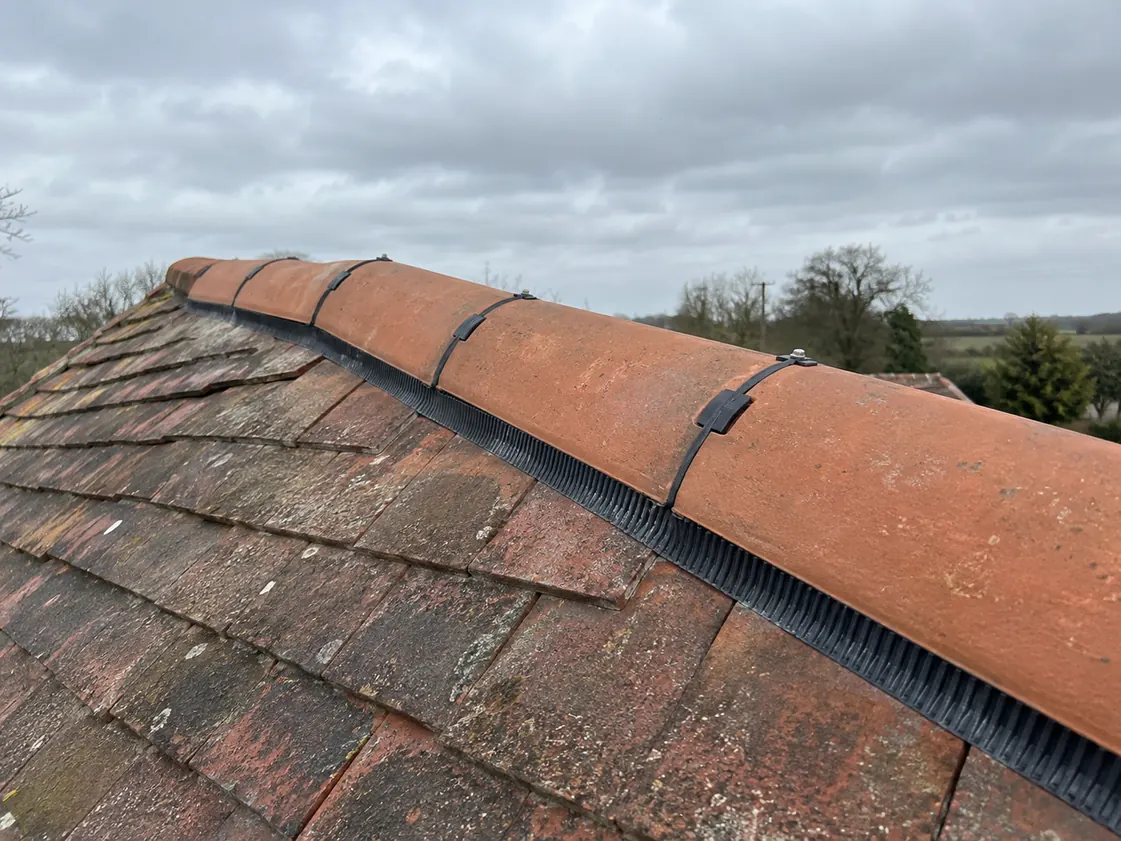
Concrete tiles are manufactured from a cement-based mixture, with colour and surface treatments varying between products. Clay tiles are formed from clay and fired, with their appearance influenced by the material and manufacturing process. Both come in different profiles, including designs that produce quite different roof textures.
The material name alone does not establish suitability. Compare the manufacturer's requirements for pitch, headlap, fixing and exposure. An interlocking concrete tile and a plain clay tile may need different layouts and supporting details, so they should not be treated as interchangeable simply because both are roof tiles.
Compare weight by product, not material
It is misleading to say that concrete is always heavier than clay. Installed weight depends on the particular tile, the number needed across the roof and the specified overlap. Individual tile weight is not the same as the covering's weight per unit of roof area.
Ask for the installed loading of the proposed product and compare it with the existing covering. Battens, supporting timbers and any alterations also matter. Where suitability is uncertain, a structural assessment should establish whether the roof can carry the proposed arrangement rather than relying on a broad material comparison.
Appearance, profile and changing colour
Concrete roof tiles offer varied colours and shapes, while clay roof tiles can provide distinctive fired tones and surface variation. Neither description guarantees a particular finish: samples and product information are more useful than assuming all concrete looks uniform or all clay looks traditional.
Consider the whole roof, including ridge fittings, verges and neighbouring buildings. Surface coatings, weathering and biological growth can alter appearance over time. View samples outside where possible, and check whether the proposed profile changes the roof's visual character or its connection with existing details.
Tiled roof work
- Tile selection considers the roof pitch and supporting structure.
- Ridges, valleys and wall junctions need attention alongside the tiles.
Scottish weather and roof exposure
Wind-driven rain, frost and exposed locations make specification important for both materials. The chosen tile must be suitable for the site's conditions, with an appropriate fixing design and compatible underlay, battens and junction details. A tile's material does not compensate for inadequate installation.
Coastal exposure, roof height and local shelter can influence fixing requirements. Valleys, abutments and penetrations need particular care because water concentrates around them. When comparing tiled roof work, consider the complete weatherproofing arrangement rather than choosing on the visible tile alone.
What affects service life
There is no reliable lifespan ranking that applies to every concrete and clay roof. Product quality, exposure, fixing condition, installation and maintenance all influence performance. A durable tile can remain sound while surrounding battens, underlay or flashings require attention.
Assess the whole assembly when deciding between repair and renewal. Widespread cracking, repeated displacement or deteriorated supporting materials need investigation, but surface colour changes alone do not prove failure. Ask what has actually deteriorated and whether the proposed work addresses that cause.
Checks before changing tile type
Changing tile can alter batten spacing, roof loading, edge levels and the way junctions fit together. Confirm pitch suitability and the available roof dimensions before ordering. Existing battens should not automatically be retained, and matching the old colour does not establish technical compatibility.
In Scotland, planning permission and building warrants are separate questions. Some straightforward repairs may not require either, while structural or material changes need closer consideration. Check the defined proposal with the council, particularly for listed buildings or conservation areas. Listed building consent may also be relevant.
Make the specification clear
For new roof work, request the tile manufacturer, product, profile, colour and associated fittings in the specification. Clarify what happens to battens, underlay, flashings and ventilation, and how concealed defects will be handled if discovered during stripping.
Keep the concrete-versus-clay decision focused on products that suit the building. The separate slate versus tile guide and natural slate types guide cover other material questions without changing the checks needed for the selected tile.
Need it sorted? Book tiled roof work
Frequently asked questions
Are concrete roof tiles always heavier than clay?
No. Compare the installed weight of the specific products, allowing for coverage and overlap. The roof structure must be checked against the proposed covering rather than a general assumption about either material.
Do clay roof tiles always last longer?
Not necessarily. Tile quality, exposure, installation and the condition of fixings and supporting materials all affect performance. A material label alone cannot predict the service life of a complete roof.
Can clay tiles replace concrete tiles on existing battens?
Only if the proposed product and existing arrangement are compatible and sound. Different tiles can require different batten spacing, fixings and detailing, so retaining battens needs assessment rather than assumption.
Does a faded concrete tile mean the roof needs replacing?
Colour change alone does not establish failure. Check for cracks, movement, water entry and deterioration beneath the covering. Replacement decisions should follow an assessment of condition, not appearance alone.
Related services
Covering Edinburgh, Perth and Dundee.