Need this sorted?
Need help with flat roofing? Get a quote from Rowan Roofing.
Rubber, fibreglass and felt explained
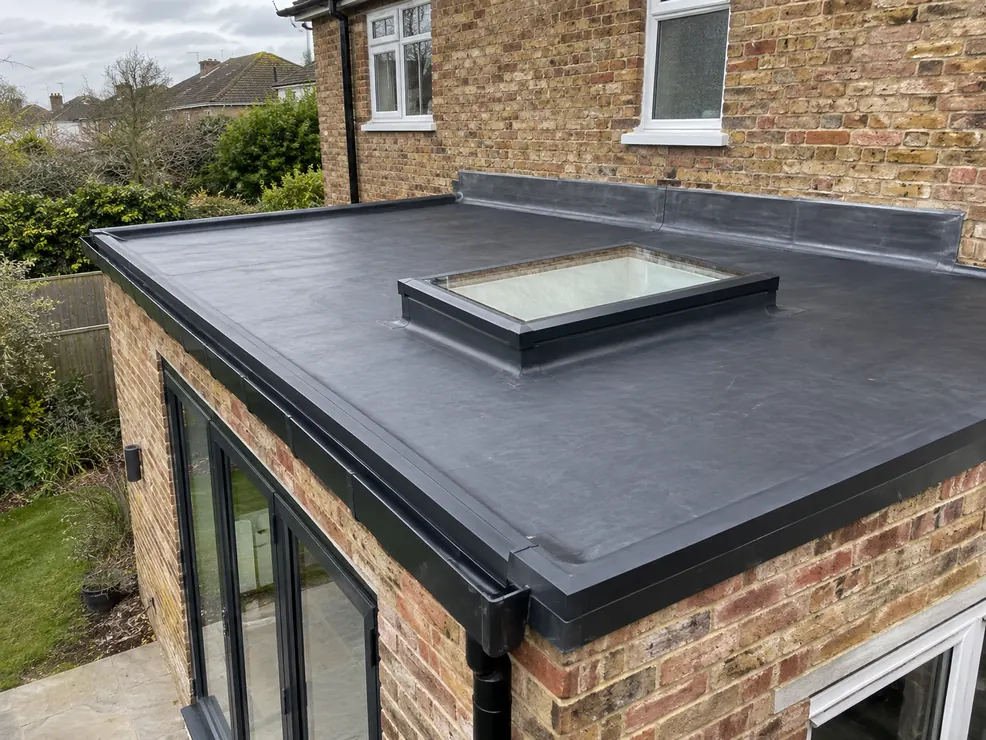
EPDM is a synthetic rubber membrane, commonly supplied in large sheets. GRP uses glass reinforcement and resin to create a rigid covering with a protective finish. Bituminous felt systems use specified layers and bonding methods to form the waterproofing. Torch-on felt bonds layers using heat, requiring suitable precautions around combustible construction and concealed cavities.
Each relies on a suitable deck and compatible components. The pages for EPDM rubber roofing, GRP fibreglass roofing and felt flat roofing explain the individual coverings and the details worth discussing in a specification.
Joints and roof shape
A straightforward EPDM roof may use a large sheet with relatively few field seams, but perimeter edges, outlets and penetrations still require careful detailing. Where seams are needed, preparation and compatible joining products are essential.
GRP forms a continuous laminated surface, with joints and movement accommodated through the specified design and trims. Felt usually includes overlapping layers and laps. Counting visible seams alone is not a reliable measure of quality: the workmanship at each junction matters more.
Decks, edges and installation conditions
A covering cannot stabilise a failing deck or correct unsuitable falls by itself. Deck condition, movement, moisture and compatibility must be assessed before installation. GRP is particularly dependent on the specified substrate and conditions during resin application and curing.
EPDM adhesives and seam products also have application requirements, while felt systems need the correct bonding method and lap formation. Upstands, thresholds and edge trims should suit the chosen system rather than being improvised around existing details. Weather-sensitive stages need allowing for in the programme, not rushed because the visible area is small.
Flat roofing
- Flat roofs for extensions, garages, porches and dormers.
- Attention to falls, deck boards, edge trims and upstands.
Drainage and the roof build-up
All three coverings need a roof designed to shed water towards suitable outlets. Persistent ponding calls for investigation of falls, deck deflection and drainage; changing the surface material alone may leave the underlying problem untouched.
Insulation and moisture control belong in the specification too. The warm flat roof page explains why the arrangement beneath the covering matters. A waterproof surface does not, by itself, prevent condensation within an unsuitable roof build-up.
Foot traffic and everyday maintenance
Ordinary domestic flat roofing should not automatically be treated as a terrace or regular walking surface. Maintenance access needs assessment, with compatible protection where required. Grit, sharp objects and equipment can damage coverings even when they appear robust.
Keep outlets clear and arrange safe checks of edges, penetrations and surface condition. EPDM can suffer punctures, GRP can develop cracks or damage around stressed details, and felt can show splits or lifting laps. Avoid walking onto a roof to investigate suspected defects.
Repairability and future alterations
EPDM repairs commonly involve compatible patches or seam materials applied to a properly prepared surface. GRP repairs may involve preparing the damaged area and rebuilding reinforcement and finish. Felt can often be locally repaired using a compatible system.
Repair suitability depends on the extent of damage and the condition beneath it. Wet insulation, a weakened deck or widespread deterioration can make a surface patch inadequate. Future rooflights or other penetrations should be planned with the existing system in mind.
Appearance and choosing a specification
EPDM generally has a plain rubber finish, GRP often presents a more rigid, uniform surface, and felt commonly has a mineral-finished texture. Edges, trims and roof visibility can influence the result as much as the main covering.
Compare flat roofing proposals on deck preparation, drainage, insulation, detailing and maintenance, not just material names. Where roof form is still undecided, the flat versus pitched roof guide considers the wider design choice.
Need it sorted? Book flat roof work
Frequently asked questions
Is fibreglass roof better than felt?
Not in every situation. GRP can provide a rigid, continuous finish, while a correctly specified felt system can also perform well. Deck suitability, movement, installation conditions and detailing should determine which is appropriate.
Are rubber roofs better than felt?
Rubber can reduce field seams on straightforward roofs and remains flexible, but felt has its own practical advantages. Neither is automatically better: compare the complete system, roof geometry, substrate preparation and maintenance requirements.
Can I walk on an EPDM or GRP roof?
Do not assume either is suitable for regular foot traffic. Maintenance access needs appropriate precautions and sometimes dedicated protection. A terrace requires a designed walking surface and suitable supporting construction, not just a waterproof covering.
Can damaged GRP be repaired locally?
Local repairs may be possible where the substrate is sound and the cause is understood. Repeated cracking, movement or moisture beneath the covering can require wider work rather than another patch over the same defect.
Will changing from felt to rubber stop ponding?
Not necessarily. Ponding may result from inadequate falls, blocked outlets or a deflecting deck. Those causes need assessment and correction within the proposed roof work, regardless of which waterproof covering is selected.
Related services
Covering Edinburgh, Perth and Dundee.